.png)


How to Generate Email Leads: A 2026 Guide for Marketers

TL;DR:
- Effective email lead generation starts with defining your audience to create targeted offers and forms.
- Using relevant lead magnets that address specific problems boosts conversion, especially when combined with optimal form placement and immediate follow-up sequences.
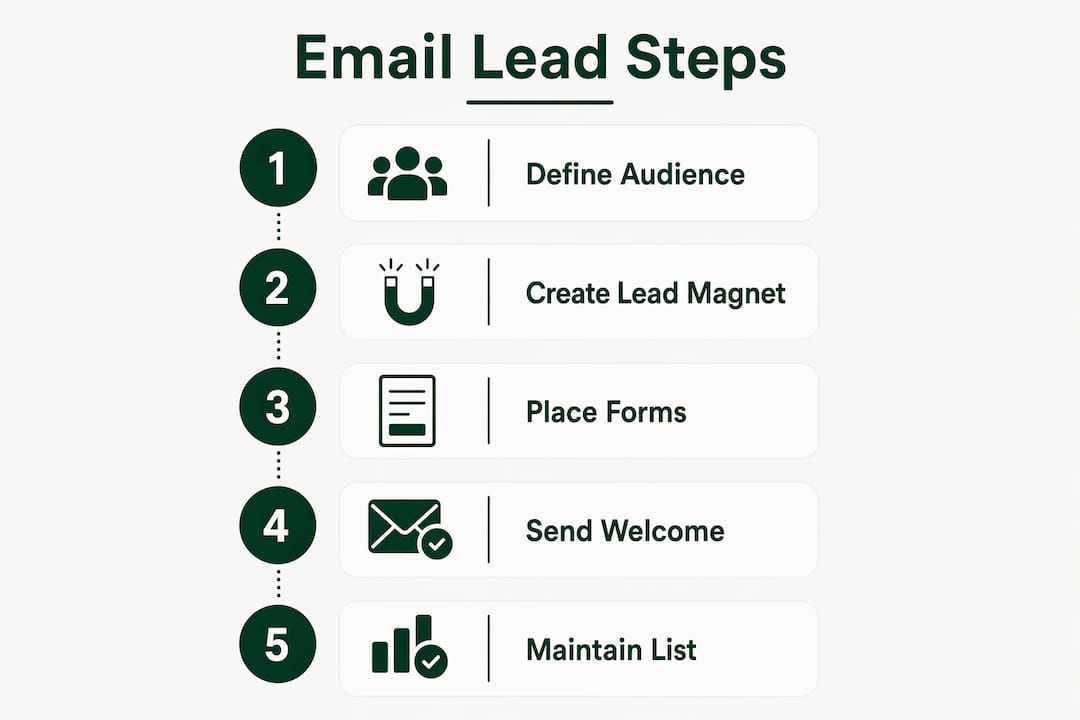
Email lead generation is the process of attracting and capturing valid email contacts through targeted offers and optimized forms to grow your marketing list and boost ROI. For small business owners and marketers, it is one of the highest-return activities in the entire marketing mix. The industry term is “email list building,” but most practitioners call it email lead generation because the goal is not just a subscriber count. The goal is a pipeline of real people who want to hear from you. This guide covers the exact steps to build that pipeline in 2026.
How to generate email leads: start with your audience
The single biggest mistake in email lead generation is skipping audience definition. If you do not know who you are trying to reach, every form, offer, and follow-up sequence will underperform.

Start by building a detailed buyer profile. Go beyond basic demographics like age and location. Include behavioral signals such as what content they consume, what problems keep them up at night, and what they have already tried. Firmographic data matters too, especially for B2B marketers. Company size, industry, and role all affect what offer will motivate a signup.
Segmentation variables to define before you build any capture asset:
- Job role or persona type (e.g., solo founder vs. marketing manager at a 50-person company)
- Stage in the buying cycle (awareness, consideration, or decision)
- Primary pain point (e.g., low repeat purchase rate, poor open rates, no automation)
- Preferred content format (video, checklist, written guide)
- Acquisition channel (organic search, paid social, referral)
Knowing these variables before you build your forms lets you write copy that speaks directly to one person, not a crowd. That specificity is what turns a passive visitor into a subscriber.
Pro Tip: Run a quick survey to your existing customers using a free tool like Google Forms or Typeform. Ask them what made them sign up and what they wish they had received sooner. Their answers will shape every lead magnet and form you build going forward.
You can also use email segmenting tips to map your audience variables directly to your ESP tags before you launch any capture campaign.
What makes a lead magnet actually convert?
A lead magnet is an offer you give in exchange for an email address. Lead magnets must solve specific, immediate problems for targeted personas to be effective. That means a generic “subscribe to our newsletter” button will almost never outperform a specific, problem-solving offer.
The most effective lead magnet formats for small business marketers include:
- Checklists and templates: Fast to consume, immediately useful, and easy to produce. A “10-point email audit checklist” outperforms a 30-page whitepaper for most audiences.
- Mini-courses delivered by email: These are powerful because they train subscribers to open your emails from day one. A 5-day email course on a specific skill builds habit and trust simultaneously.
- Industry reports or data summaries: These work well when your audience is research-driven. A short benchmark report on email open rates by industry gives professionals a reason to share their work email.
- Discount codes or free shipping offers: For e-commerce brands, a first-purchase incentive remains one of the fastest ways to grow an email list with buyers, not just browsers.
- Free tools or calculators: A simple ROI calculator embedded on your site captures high-intent leads because the visitor is already in problem-solving mode.
The match between the offer and the audience pain point determines conversion rate more than design or copy. A beautifully designed lead magnet that solves the wrong problem will still fail.
Pro Tip: Test two versions of the same lead magnet with different specificity levels. “Free marketing guide” vs. “Free 5-step email sequence for e-commerce brands under $1M revenue.” The specific version almost always wins because it signals that you understand the reader’s exact situation.
For a broader look at proven list growth strategies that pair well with strong lead magnets, that resource covers complementary tactics worth reviewing.
Where and how to place email capture forms
Form design and placement determine whether a visitor converts or leaves. Lead capture forms with 2–3 fields have the highest conversion rates. Every additional field you add reduces submission rates. For most campaigns, first name and email address is the right combination.
The four most effective form placements, ranked by typical conversion impact:
- Exit-intent modal: Triggered when a visitor moves their cursor toward the browser tab or back button. This placement catches people who are about to leave and gives you one last chance to offer value.
- Inline content form: Embedded within a blog post or article, ideally after the reader has consumed enough content to trust you. Contextual relevance here is everything.
- Sticky header or footer bar: Always visible as the reader scrolls. Low friction, low distraction, and effective for high-traffic pages.
- Dedicated landing page: A standalone page with no navigation links, built solely to convert one specific offer. This is the highest-converting format when paired with paid traffic.
Using multiple form placement types captures diverse audience segments better than relying on a single approach. A visitor who ignores your header bar may respond to an exit-intent modal. A reader who skips the modal may submit the inline form after finishing your article.
One underused tactic is the multi-step form. The first step asks only for an email address. After submission, a second step asks one segmentation question, such as “What best describes your business?” Adding a single segmentation question in lead capture forms lets you apply tags immediately and trigger relevant workflows. You get richer data without losing the conversion.
| Form type | Best use case |
|---|---|
| Exit-intent modal | Recovering abandoning visitors with a strong offer |
| Inline content form | Capturing engaged readers mid-article |
| Sticky bar | Persistent visibility on high-traffic pages |
| Dedicated landing page | Paid traffic and single-offer campaigns |
| Multi-step form | Collecting segmentation data without reducing signups |
How do follow-up sequences turn leads into customers?
Capturing an email address is only the beginning. What you send in the first 24 hours determines whether that lead becomes a customer or goes cold.
Welcome emails sent within the first hour of signup achieve the highest open and click rates. That first hour is when intent is at its peak. The subscriber just raised their hand. Send them exactly what they asked for, immediately, and follow it with a short sequence that builds on that initial interest.
Welcome sequences should be customized to the specific asset or intent that triggered signup for better engagement and conversion rates. A subscriber who downloaded a discount code needs a different sequence than one who downloaded a technical guide. Treating them the same wastes the context you already have.
Segmenting leads by acquisition source from day one enables targeted nurturing and improves conversion rates. Tag every lead with their source (organic blog, paid ad, referral partner) and their entry offer. Those two data points alone let you write follow-up messages that feel personal without requiring manual effort.
A strong nurture sequence by lifecycle stage looks like this:
- Day 0 (immediate): Deliver the promised asset. Confirm the signup. Set expectations for what comes next.
- Day 1–3: Share one piece of content that solves the next logical problem after the lead magnet.
- Day 4–7: Introduce your brand story or proof. A short case study or customer result works well here.
- Day 8–14: Make a soft offer. A free consultation, a product trial, or a limited-time discount tied to their specific interest.
Lifecycle mapping with differentiated messaging based on lead intent and stage increases conversion rates significantly. The goal is to match your message to where the subscriber is mentally, not just where they are in your funnel.
You can also deepen this approach by studying lifecycle email marketing frameworks that map message types to each stage of the customer relationship.
Why list quality matters more than list size
A large list with poor hygiene will hurt your sender reputation and reduce deliverability across your entire program. Validating emails at capture and using double opt-in processes guards against high bounce rates and protects sender reputation. Both practices are non-negotiable for any marketer who plans to scale.
Double opt-in adds one extra step: after submitting a form, the subscriber receives a confirmation email and must click a link to verify their address. This filters out typos, fake addresses, and low-intent signups. The result is a smaller but far more engaged list. Learn more about double opt-in benefits and how to implement it without losing good subscribers.
For outbound or cold email programs, infrastructure setup is equally critical. Effective cold email lead generation requires isolating sending infrastructure and warming mailboxes to maintain domain reputation before scaling outreach. Sending high volumes from a cold domain will trigger spam filters and blacklist your sending address within days.
Pro Tip: Run a re-engagement campaign every 90 days targeting subscribers who have not opened in 60 days. Give them one clear reason to stay. If they do not engage, remove them. A clean list of 5,000 active subscribers outperforms a bloated list of 20,000 disengaged ones every time.
Key Takeaways
Generating high-quality email leads requires a system that combines audience clarity, relevant offers, smart form placement, and immediate follow-up to convert subscribers into buyers.
| Point | Details |
|---|---|
| Define your audience first | Build detailed buyer profiles before creating any lead magnet or capture form. |
| Match offers to pain points | Lead magnets that solve specific, immediate problems consistently outperform generic incentives. |
| Use 2–3 field forms | Shorter forms convert at higher rates; add a segmentation question in a second step. |
| Send welcome emails immediately | The first hour after signup delivers the highest open and click rates. |
| Prioritize list hygiene | Double opt-in and email validation protect deliverability and long-term ROI. |
What I’ve learned after years of watching email programs succeed and fail
The most common mistake I see small business owners make is treating email lead generation as a one-time setup task. They build a form, write one welcome email, and assume the system will run itself. It does not. The brands that consistently grow high-quality lists treat every touchpoint as a data source. They tag every lead, review form performance monthly, and update their lead magnets when conversion rates drop.
The second mistake is chasing volume over quality. A list of 50,000 unverified, unsegmented contacts sounds impressive until your open rates drop below 10% and your domain gets flagged. I have seen brands with 8,000 highly segmented subscribers outperform competitors with 80,000 cold contacts because their messages landed in the inbox and matched what the reader actually wanted.
The third thing most articles will not tell you is this: your lead magnet is a promise about your brand. If the offer is generic, the subscriber expects generic emails. If the offer is specific, useful, and well-crafted, the subscriber expects the same from everything you send. That expectation shapes your entire relationship with that contact from day one.
Build the system right from the start. Tag every lead at the source. Customize your welcome sequence to the offer that triggered the signup. Validate your list regularly. These are not advanced tactics. They are the baseline for any email program that actually grows revenue.
— Melanie
How Theemailmarketers helps brands build and convert email leads
Theemailmarketers works with e-commerce brands and DTC companies that need more than a signup form and a welcome email. The team builds complete lead generation systems: segmented capture flows, automated nurture sequences, and lifecycle campaigns designed to turn new subscribers into repeat buyers. If you want to see what that looks like in practice, the email marketing case studies show real results from brands that have gone through the full process. For brands ready to build a retention-focused email program from the ground up, the Retention Lab is the right starting point.
FAQ
What is email lead generation?
Email lead generation is the process of capturing valid email addresses from potential customers through targeted offers, optimized forms, and strategic placement across your marketing channels.
How many fields should an email capture form have?
Forms with 2–3 fields convert at the highest rates. Use first name and email address as your baseline, then collect additional data through a multi-step form after the initial submission.
When should I send a welcome email after someone signs up?
Send the welcome email within the first hour of signup. That window delivers the highest open and click rates because subscriber intent is at its peak immediately after they opt in.
What is double opt-in and why does it matter?
Double opt-in requires subscribers to confirm their email address after signing up. It filters out fake addresses and low-intent signups, which protects your sender reputation and improves long-term deliverability.
How do I keep my email list healthy over time?
Validate emails at the point of capture, use double opt-in, and run re-engagement campaigns every 90 days. Remove subscribers who do not engage after a re-engagement attempt to maintain strong deliverability.


