.png)


Master email marketing frequency for better retention

Most DTC brands assume the path to more revenue is simple: send more emails. It’s a logical leap, but it’s wrong. Sending emails too frequently increases unsubscribe rates and can actively erode the customer lifetime value (CLV) you’ve worked hard to build. The brands winning at retention aren’t the ones flooding inboxes. They’re the ones sending the right message at the right cadence, backed by data. This guide breaks down the evidence-based frameworks, segmentation strategies, and testing methods that help high-growth DTC brands get email frequency exactly right.
Table of Contents
- Why email frequency matters for DTC brands
- Determining the ideal send frequency: Core principles
- How to use segmentation to fine-tune email frequency
- Testing and optimizing your send cadence
- Danger signs: When email frequency is hurting rather than helping
- Best practices to tailor email frequency for maximum customer lifetime value
- Expert help for mastering your brand’s email frequency
- Frequently asked questions
Key Takeaways
| Point | Details |
|---|---|
| No magic number | The best email frequency depends on your audience, not a one-size-fits-all rule. |
| Segment for success | Tailor send rates by segment to boost engagement and retention. |
| Test and adapt | Regular A/B testing of send frequency prevents fatigue and lost revenue. |
| Watch for warning signs | Monitor metrics like unsubscribes and spam complaints to avoid damaging your list. |
| Best practices matter | Blend data, strategy, and tools to maximize CLV with effective email cadence. |
Why email frequency matters for DTC brands
Email marketing frequency refers to how often you send campaigns to your list, whether daily, weekly, or monthly. It sounds simple, but it’s one of the most consequential decisions in your retention strategy. Get it right, and you build a loyal customer base that buys again and again. Get it wrong, and you’re burning through your list faster than you’re growing it.
Optimal email frequency directly boosts retention rates and increases overall CLV. That’s not a soft benefit. For an 8-figure DTC brand, even a 5% improvement in retention can translate to hundreds of thousands of dollars in incremental revenue annually. The math makes frequency a board-level conversation, not just a marketing ops decision.
Under-emailing is just as dangerous as over-emailing. Send too rarely and customers forget you exist, your open rates drop, and competitors fill the gap. Send too often and you trigger unsubscribes, spam complaints, and inbox fatigue. Both extremes cost you money.
Here are the key business metrics directly affected by email frequency:
- Unsubscribe rate: Spikes when frequency exceeds audience tolerance
- Open rate: Declines as inbox fatigue sets in from over-sending
- Click-through rate (CTR): Drops when emails feel repetitive or irrelevant
- Revenue per email: Falls when list quality degrades from churn
- Spam complaint rate: Rises with aggressive send schedules
- Customer lifetime value: Shrinks when retention suffers from poor frequency management
Determining the ideal send frequency: Core principles
There is no universal magic number. A luxury skincare brand sending daily emails will see very different results than a pet food subscription brand doing the same. Your ideal cadence depends on your audience, your product, and the signals your data is already sending you.
The factors that matter most are product type, buying cycle, seasonality, and engagement signals. A high-replenishment product like coffee or supplements can support more frequent sends because the purchase cycle is short. A considered-purchase category like furniture or electronics needs a slower, more educational cadence. Audience segment, product lifecycle, and engagement data drive the best frequency decisions, not gut instinct.

Here’s how typical send frequencies break down across major DTC verticals:
| Vertical | Typical weekly sends | Typical monthly sends | Notes |
|---|---|---|---|
| Beauty and skincare | 2-4 | 8-16 | High repurchase, trend-driven |
| Apparel and fashion | 2-3 | 8-12 | Seasonal peaks require flexibility |
| Health and supplements | 3-5 | 12-20 | Education-heavy content supports frequency |
| Home and furniture | 1-2 | 4-8 | Longer buying cycles, lower tolerance |
| Food and beverage | 2-4 | 8-16 | Subscription models support higher cadence |
| Pet products | 2-3 | 8-12 | Loyalty-driven, moderate frequency |
Seasonality adds another layer. Q4 is the one period where nearly every vertical can push frequency higher without the usual blowback, because customers expect it and are actively shopping. Outside of peak seasons, pull back and let your engagement data guide you. Pair your frequency decisions with a strong timing strategy to maximize the impact of every send.
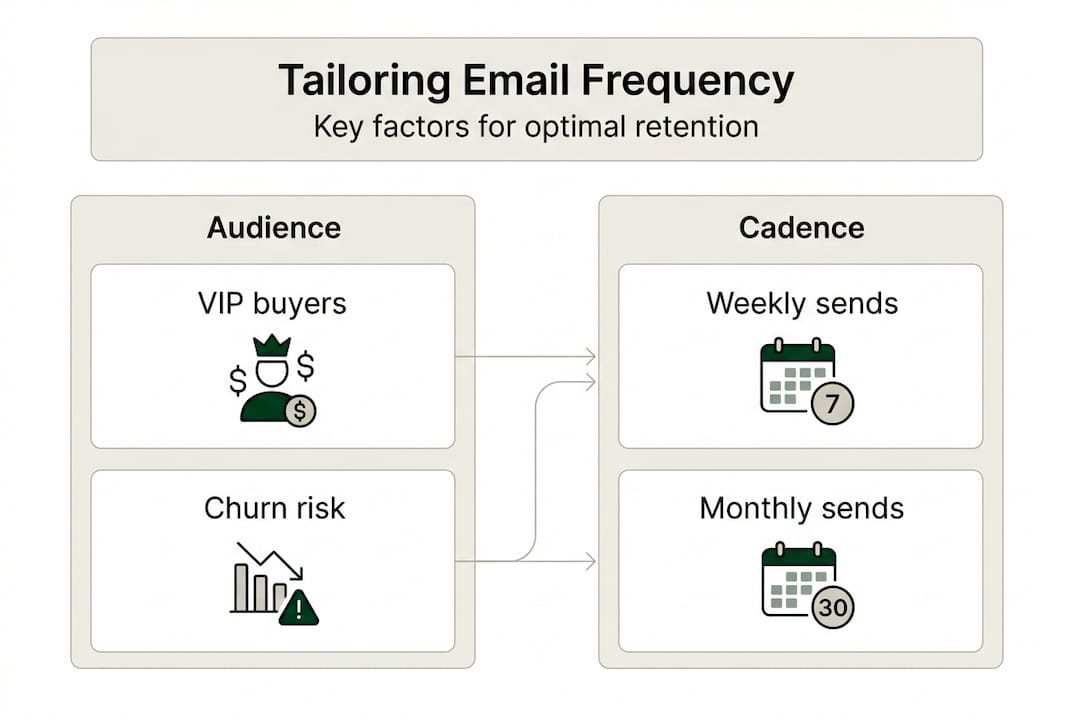
Pro Tip: Don’t measure frequency at the list level. Measure it per segment. Your VIP buyers can handle more emails than someone who opened once six months ago. Tracking segmenting emails by engagement tier gives you a far more accurate picture of what’s working.
How to use segmentation to fine-tune email frequency
Segmentation transforms frequency from a blunt instrument into a precision tool. Instead of sending the same cadence to your entire list, you tailor it based on how each group actually behaves. That shift alone can meaningfully reduce unsubscribes while lifting revenue.
Segmenting your list allows you to tailor frequency, improving engagement and reducing opt-outs across the board. The three most powerful segmentation signals for frequency decisions are engagement level, purchase history, and stated preferences.
Here’s how open and click rates typically vary by segment, and what frequency that supports:
| Segment | Avg. open rate | Avg. CTR | Recommended frequency |
|---|---|---|---|
| VIP buyers (3+ purchases) | 45-55% | 8-12% | 4-5x per week |
| Active subscribers (opened in 90 days) | 30-40% | 4-7% | 2-3x per week |
| Lapsed subscribers (90-180 days inactive) | 15-22% | 1-3% | 1x per week |
| Win-back targets (180+ days inactive) | 8-14% | 0.5-2% | 1-2x per month |
| New subscribers (0-30 days) | 35-50% | 5-9% | 3-4x per week (welcome flow) |
Practical segmentation strategies that move the needle for DTC brands:
- RFM segmentation: Group customers by recency, frequency, and monetary value to assign send cadences that match their relationship with your brand
- Engagement-based suppression: Automatically reduce frequency for subscribers who haven’t opened in 60 days, rather than letting them drift toward unsubscribing
- Post-purchase sequences: Trigger a dedicated flow after every purchase with a cadence built around the product’s natural replenishment cycle
- Preference-driven frequency: Use a personalized emails approach where subscribers self-select their preferred send rate
- Category-based lists: Segment by product interest so subscribers only receive emails relevant to what they’ve browsed or bought
The segmentation basics you set up today compound over time. Every send teaches you more about what each group tolerates and values, making your frequency decisions sharper with every campaign.
Testing and optimizing your send cadence
Personalizing frequency is not a one-time setup. It’s an ongoing process of testing, reading data, and adjusting. A/B testing (also called split testing) helps you identify your most effective frequency and prevent unsubscribes before they become a trend.
Here’s a step-by-step process for running a frequency split test:
- Define your test segments: Split a single audience segment into two equal groups with similar engagement profiles
- Set your frequency variables: Group A receives your current cadence (e.g., 3x per week), Group B receives a modified cadence (e.g., 2x per week)
- Run the test for at least 4 weeks: Shorter windows don’t capture enough behavioral data to be reliable
- Track the right metrics: Focus on unsubscribe rate, revenue per email, and CTR, not just open rate
- Analyze by segment, not list-wide: A frequency that works for VIPs may tank for lapsed subscribers
- Implement the winner and retest quarterly: Audience behavior shifts, so your optimal cadence will too
Signs you’re sending too often include a rising unsubscribe rate (above 0.5% per send), declining CTR across multiple consecutive campaigns, and an uptick in spam complaints. If you see two or more of these together, reduce frequency immediately for that segment. Increasing revenue with A/B tests is not just about subject lines. Cadence testing is one of the highest-leverage experiments you can run.
Pro Tip: Use a holdout group, a small portion of your list that receives no emails during the test period. Comparing their purchase behavior to your test groups gives you a clean baseline and reveals the true revenue impact of your frequency changes.
Danger signs: When email frequency is hurting rather than helping
Even with solid segmentation and testing in place, frequency problems can sneak up on you. The warning signs are usually visible in your data before customers start complaining directly.
“Too many emails is one of the top reasons customers unsubscribe and disengage permanently. Once they’re gone, winning them back costs significantly more than keeping them in the first place.” General Case Study, The Email Marketers
The consequences of over-emailing are real and compounding. High unsubscribe rates shrink your list. Spam complaints damage your sender reputation, which hurts deliverability for everyone on your list, not just the complainers. And email loyalty examples from brands like Amazon show that even the biggest players carefully calibrate frequency to protect long-term engagement.
Under-emailing carries its own risks. Brands that go quiet for weeks at a time see open rates collapse when they return, because subscribers no longer recognize them. Consistency matters as much as volume.
Watch for these five red flags that signal urgent frequency changes are needed:
- Unsubscribe rate exceeds 0.5% per send: This is the clearest signal you’re in over-sending territory
- Spam complaint rate rises above 0.1%: Internet service providers (ISPs) use this threshold to flag senders
- Open rates drop more than 20% over 30 days: Inbox fatigue is setting in across your list
- Revenue per email declines for 3+ consecutive sends: Subscribers are tuning out, not just opening less
- Customer service receives direct complaints about email volume: This is rare but serious when it happens
Review common email marketing problems regularly as part of your monthly performance audit. Catching these signals early is far cheaper than rebuilding a damaged list.
Best practices to tailor email frequency for maximum customer lifetime value
The brands with the strongest retention programs don’t guess at frequency. They build systems that continuously optimize it. Here’s how the top DTC brands lock in the right cadence and protect CLV over the long term.
Brands that combine data-driven testing, segmentation, and content relevance consistently outperform those relying on fixed send schedules. The following practices are what separate retention leaders from the rest:
- Start with a frequency audit: Before changing anything, benchmark your current open rates, CTR, unsubscribe rates, and revenue per email by segment
- Build a preference center: Let subscribers choose how often they hear from you. This simple feature can cut unsubscribes by 20-30% while keeping your most engaged customers happy
- Tie frequency to the customer journey stage: New subscribers need more touchpoints. Loyal buyers need fewer but higher-value sends. Lapsed customers need a re-engagement sequence, not more of the same
- Review cadence quarterly, not annually: Audience behavior, seasonality, and competitive dynamics shift. Your frequency strategy should shift with them
- Suppress unengaged subscribers proactively: Don’t wait for unsubscribes. Reduce frequency for anyone who hasn’t engaged in 60 days and run a win-back flow before removing them
- Match content quality to frequency: If you’re sending 4x per week, every email needs to earn its place. Filler content at high frequency is the fastest way to train your list to ignore you
- Monitor deliverability alongside engagement: Frequency affects your sender score. Track inbox placement rates alongside open and click metrics to catch deliverability issues early
Expert help for mastering your brand’s email frequency
Getting email frequency right is one of the highest-ROI moves a DTC brand can make, but it requires the right data infrastructure, segmentation logic, and testing discipline to execute consistently. At The Email Marketers, we help 8-figure brands build frequency strategies that protect list health and grow CLV at the same time. Our email marketing case studies show exactly how we’ve helped brands reduce unsubscribes while increasing revenue per send. If you’re ready to move beyond guesswork, explore our Retention Lab for hands-on strategy support, or grab our Retention Toolkit to start optimizing your cadence today.
Frequently asked questions
How many emails per week is too many for ecommerce brands?
Sending more than 3-5 emails per week typically raises unsubscribe rates for most ecommerce audiences. The right ceiling depends on your segment, but exceeding five sends per week without strong engagement data to justify it is a risk most brands shouldn’t take.
What metrics should I watch to know if my email frequency is working?
Track open rates, click-through rates, unsubscribe rates, and revenue per email as your core frequency health indicators. Engagement and unsubscribe metrics signal when to pull back or push forward on cadence.
Does email frequency affect deliverability?
Yes. High-frequency sending can trigger spam filters and damage your sender reputation, reducing inbox placement rates across your entire list, not just for the subscribers who complained.
How do I personalize send frequency for different customers?
Use segmentation and engagement data to assign different send cadences to different groups based on purchase history, activity level, and stated preferences. Personalized frequency increases relevance and reduces opt-outs.
Can a preference center reduce unsubscribes?
Yes. A preference center lets customers choose their ideal email frequency, which keeps them on your list at a cadence they’re comfortable with rather than forcing them to unsubscribe entirely.
Recommended
- How Often Should Email Marketing Be Sent?
- The Email Marketers Are Climbing The Ranks of The Email Marketing Industry
- Understanding Email Marketing Metrics
- 4 Examples of Effective Retail Email Marketing
- Amazon Email Marketing: Driving Sales and Loyalty - Searchoneers
- Vodič za email marketing: izboljšajte strategije 2026


